
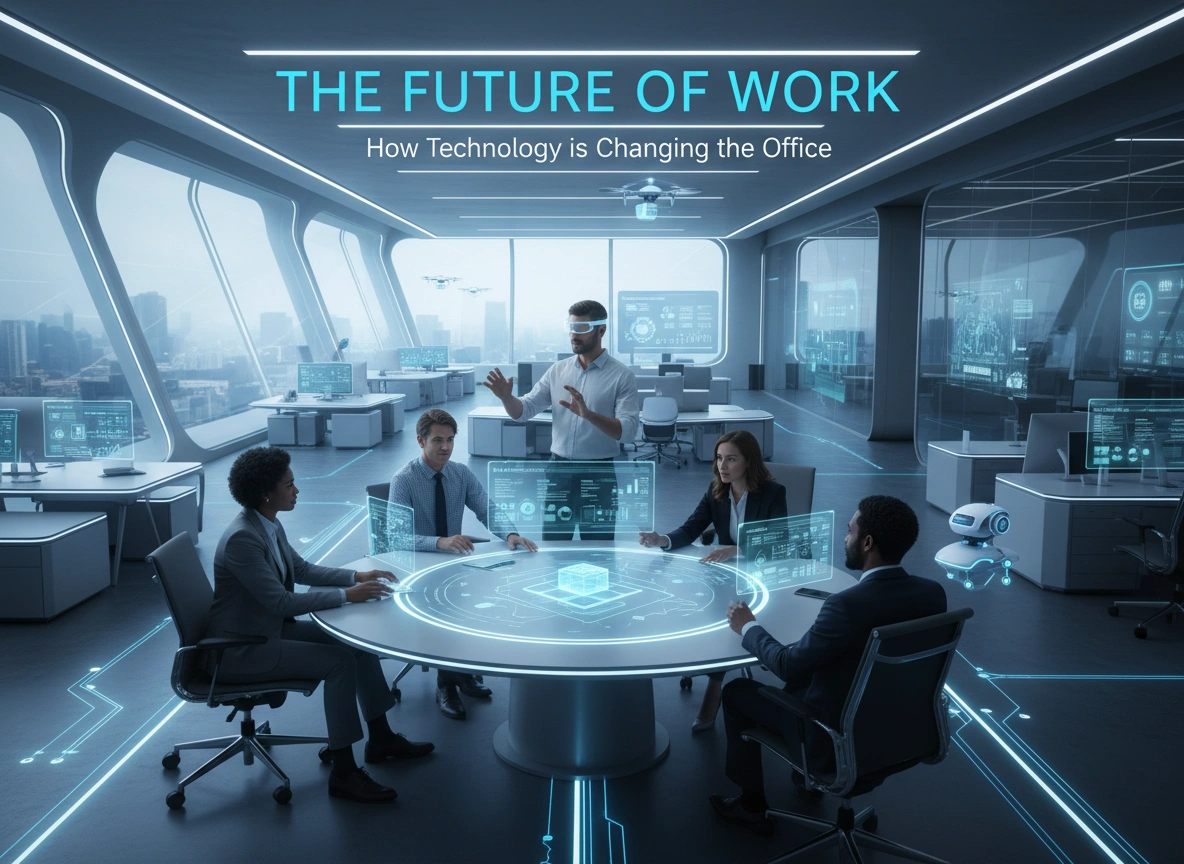
The corner office with a mahogany desk is no longer the ultimate symbol of corporate success. In fact, the office itself—once a rigid destination where employees clocked in at nine and left at five—is undergoing a radical metamorphosis. We are witnessing a shift that goes beyond new furniture or open floor plans. Technology is fundamentally rewriting the DNA of how, where, and why we work.
The traditional office model has served us for decades, but it is buckling under the weight of innovation. Businesses that cling to old methodologies risk obsolescence, while those that embrace the digital revolution find themselves leaner, faster, and more adaptable. This transformation isn’t just about efficiency; it is about redefining the human relationship with labor. As we navigate this new landscape, we must understand the key drivers reshaping our professional lives: the rise of hybrid models, the integration of artificial intelligence, the evolution of collaboration, and the critical focus on employee well-being.
The dissolution of physical boundaries: Remote and hybrid work
The most visible change in the modern workplace is the disappearance of the mandatory daily commute. What began as a necessity during global disruptions has solidified into a permanent feature of the corporate world. High-speed internet and cloud computing have severed the tether between productivity and physical proximity.
The rise of the “Anywhere Office”
The concept of the “anywhere office” allows employees to contribute from home studies, co-working spaces, or coffee shops across the globe. This shift has democratized talent acquisition. Companies are no longer restricted to hiring candidates within a 30-mile radius of their headquarters. Instead, they can tap into a global talent pool, finding the best skills regardless of geography.
However, this freedom comes with logistical challenges. Organizations must now manage asynchronous communication and ensure that culture translates across time zones. We are seeing a move away from tracking hours worked to tracking output and results. The focus is no longer on being seen at a desk but on the value delivered.
Hybrid models as the new standard
While remote work offers flexibility, the physical office is not dead; it is being repurposed. Many organizations are adopting hybrid models where employees split their time between home and the office. In this setup, the office becomes a collaboration hub—a place for brainstorming, team building, and social interaction—rather than a factory for individual tasks. This requires office spaces to be redesigned with more “we space” (meeting rooms, lounges) and less “me space” (cubicles).
AI and Automation: The new coworkers
If remote work changed where we work, Artificial Intelligence (AI) and automation are changing what we do. The narrative that robots will steal all jobs is an oversimplification. The reality is more nuanced: AI is becoming a powerful coworker that augments human capabilities.
Automating the mundane
Automation is stripping away repetitive, low-value tasks that have historically bogged down productivity. Data entry, scheduling, basic customer service inquiries, and invoice processing are increasingly handled by algorithms. This shift liberates human workers to focus on high-value activities that require critical thinking, emotional intelligence, and creativity.
For example, in the legal sector, AI tools can review thousands of documents in minutes—a task that would take junior associates weeks. This doesn’t necessarily replace the lawyer; it frees them to focus on strategy and client counseling.
Generative AI and creative assistance
Generative AI is pushing boundaries even further by assisting in content creation, coding, and design. Tools that can draft emails, generate code snippets, or create visual assets are becoming standard in the digital toolkit. The role of the worker is shifting from “creator” to “editor and strategist.” The skill of the future will not just be doing the work, but knowing how to prompt the machine to do it effectively and then refining the output.
This technological integration requires a commitment to upskilling. As roles evolve, continuous learning becomes non-negotiable. Companies must invest in training programs to ensure their workforce can leverage these new tools rather than be displaced by them.
The evolution of collaboration tools
The whiteboard has gone digital. As teams disperse, the tools we use to connect have become the central nervous system of the organization. Email, once the undisputed king of communication, is being dethroned by dynamic platforms designed for real-time interaction.
Beyond video conferencing
While video calls bridge the visual gap, they are only one piece of the puzzle. The future of collaboration lies in persistent digital workspaces—platforms like Slack, Microsoft Teams, and Asana—where work happens in the open. These tools create a digital trail of decisions, files, and discussions, making information accessible to everyone, regardless of when or where they log on.
We are also seeing the emergence of immersive technologies. Virtual Reality (VR) and Augmented Reality (AR) are moving from gaming into the boardroom. Architects can walk clients through 3D models of buildings from miles away. Product designers can manipulate virtual prototypes in a shared digital space. These tools attempt to replicate the serendipity and nuance of face-to-face interaction that 2D screens often miss.
The challenge of digital noise
The proliferation of these tools brings a new challenge: digital noise. The constant ping of notifications can shatter focus and lead to burnout. The future workplace requires “digital hygiene” policies. This might look like “no-meeting Fridays” or established “deep work” hours where employees are encouraged to disconnect from messaging apps to focus on complex tasks without interruption.
Technology’s impact on employee well-being
For a long time, technology was viewed purely as a productivity booster. Now, we are recognizing its profound impact—both positive and negative—on employee mental health and well-being. The “always-on” culture created by smartphones and laptops has blurred the lines between work and life, leading to significant stress.
Tech for health
Conversely, technology is also being deployed to solve these problems. We are seeing a rise in “HealthTech” within the enterprise. Wearable devices and apps can track stress levels, remind employees to take breaks, and encourage physical movement. Some companies use sentiment analysis tools to gauge morale by analyzing communication patterns (anonymously) to detect signs of burnout across teams before employees resign.
Designing for disconnection
Forward-thinking organizations are using technology to enforce boundaries. Smart scheduling assistants can automatically decline meetings scheduled outside of working hours. Email servers can be configured to hold messages sent on weekends until Monday morning. The goal is to use technology to protect the human capacity for rest, recognizing that a rested worker is a more productive and creative one.
Prioritizing well-being is no longer just a “nice-to-have” perk; it is a strategic imperative. In a competitive talent market, companies that use technology to support a healthy work-life balance will win the loyalty of top performers.
What the future holds
The trajectory is clear: the workplace of the future will be fluid, intelligent, and hyper-connected. We can expect to see the physical and digital worlds merge even further.
The Metaverse and spatial computing may eventually create virtual offices that feel as real as physical ones, allowing avatars to interact with a level of presence currently impossible in video calls. Predictive analytics will likely guide management decisions, helping leaders understand workflow bottlenecks and team dynamics with data-driven precision.
However, the most successful organizations will be those that remember that technology is a tool, not a master. The future of work isn’t just about the smartest AI or the fastest cloud server. It is about how these technologies empower people.
The companies that thrive will be those that use automation to make work more meaningful, use connectivity to build genuine communities, and use data to support human well-being. We are not just building a more efficient office; we are building a more human-centric one, powered by the very best that technology has to offer. The future of work is here, and it is waiting for us to log in.
Please visit this website for more info.
