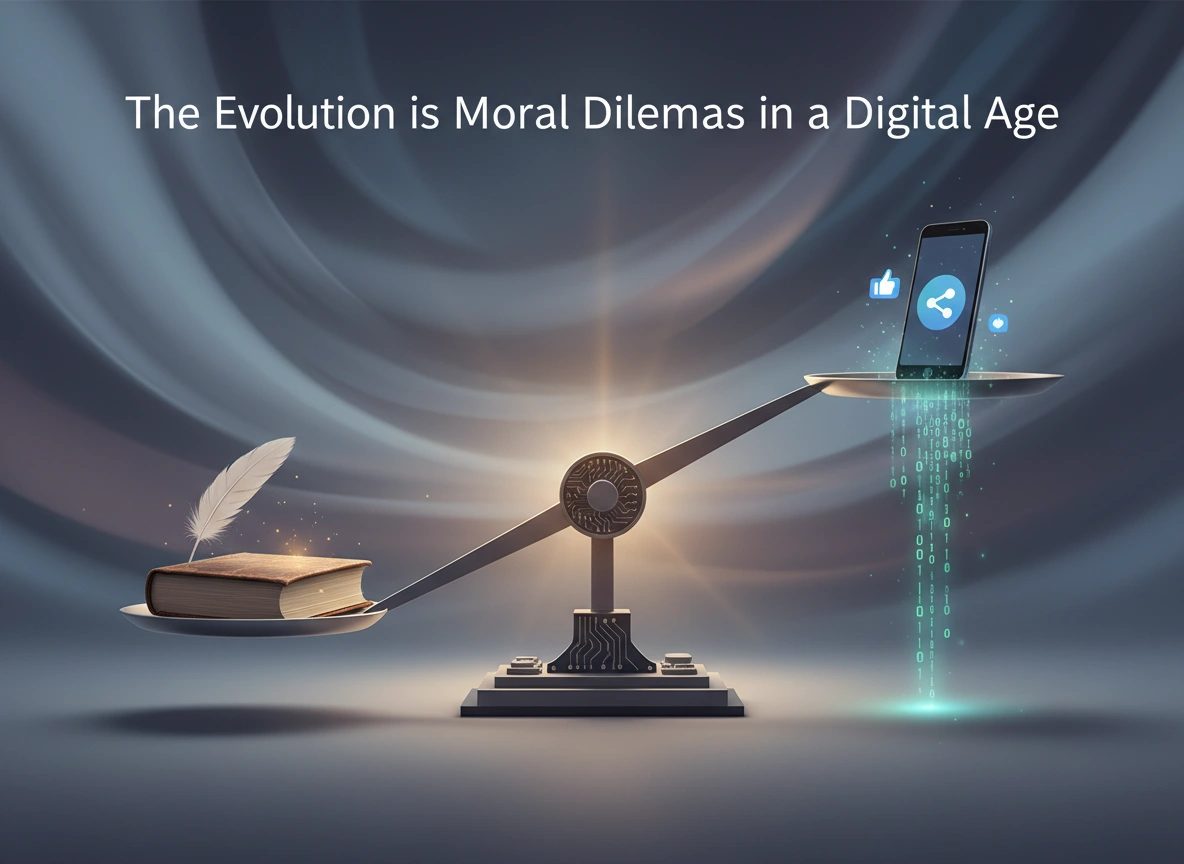
Moral dilemmas are as old as human society itself. From ancient philosophical debates to personal struggles of conscience, the challenge of choosing between two conflicting ethical principles has always been a fundamental part of our experience. For centuries, these dilemmas played out in physical spaces, governed by social norms and tangible consequences. However, the dawn of the digital age has fundamentally altered the landscape of morality, introducing a new class of ethical challenges that are faster, broader, and more complex than ever before. Technology has not just given us new tools; it has rewired our social interactions, reshaped our sense of self, and created novel arenas for moral conflict.
The evolution of these dilemmas is not merely about applying old principles to new situations. Instead, digital technology has given rise to entirely new categories of ethical questions. Issues that were once confined to science fiction—such as the rights of artificial beings or the manipulation of reality on a mass scale—are now pressing contemporary concerns. Understanding this evolution requires us to examine how the core tenets of our moral frameworks are being tested by the unique characteristics of the digital world: anonymity, permanence, speed, and scale.
The Shifting Sands of Privacy
Historically, the concept of privacy was tied to physical space and personal property. A person’s home was their castle, and private conversations were those held behind closed doors. The primary moral dilemma was often a conflict between an individual’s right to seclusion and a community’s need for information or security. While governments and institutions have always posed a threat to privacy, the digital age has democratized surveillance and made it pervasive.
Today, the moral dilemma of privacy is far more intricate. Every click, search, and online interaction generates a trail of data. The conflict is no longer just about preventing intrusion but about managing consent and ownership of one’s digital identity. When you use a “free” social media platform or a navigation app, you are implicitly trading personal data for service. The ethical question becomes: is this a fair exchange? Do users truly understand the scope of the data they are giving away, and do corporations have a moral obligation to be more transparent?
Furthermore, the rise of the Internet of Things (IoT) brings these dilemmas directly into our homes. Smart speakers that are always listening and security cameras that stream to the cloud create a conflict between convenience and vulnerability. The ethical challenge for developers, corporations, and consumers is to navigate a world where the line between helpful assistance and intrusive monitoring is dangerously thin. The permanence of digital information adds another layer; a youthful mistake posted online can have lifelong consequences, forcing us to reconsider our societal values around forgiveness and the right to be forgotten.
The Moral Maze of Artificial Intelligence
The development of artificial intelligence (AI) has moved from theoretical discussions to practical application, embedding complex ethical challenges into our daily lives. Historically, moral agency was exclusive to humans. We built tools, and we were responsible for how they were used. AI complicates this by introducing systems that can learn, make decisions, and act autonomously.
One of the most significant moral dilemmas in AI involves algorithmic bias. AI systems are trained on vast datasets that reflect existing societal biases. Consequently, an AI used for hiring might discriminate against female candidates, or a facial recognition system may be less accurate for people of color. The ethical conflict here is profound: are the creators of the algorithm responsible for its biased outcomes, or is the AI itself culpable? This challenges our traditional notions of accountability. When a self-driving car is faced with an unavoidable accident and must choose between hitting a pedestrian or swerving to risk its passenger, the decision is no longer made by a human in a split second. It is programmed in advance, turning a tragic accident into a pre-meditated ethical choice encoded in software.
As we move toward more sophisticated AI, we will face even deeper questions. What rights, if any, should a sentient AI possess? Is it morally permissible to create a conscious being designed solely for servitude? These questions force a confrontation between our role as creators and our ethical duties to the things we create, pushing the boundaries of what it means to be a moral agent.
Ethics in the Echo Chamber of Social Media
Social media platforms have revolutionized communication, connecting billions of people across the globe. Yet, they have also become fertile ground for new and pernicious moral dilemmas. The core conflict often revolves around free speech versus the prevention of harm. Platforms are caught between upholding the principle of open expression and their responsibility to police hate speech, harassment, and dangerous content.
The design of these platforms introduces another ethical problem: the attention economy. Algorithms are optimized to maximize engagement, which often means promoting sensational, divisive, and emotionally charged content. This business model creates a moral hazard where profitability is directly tied to a less informed and more polarized public square. Users, in turn, face their own dilemmas. The impulse to share, like, and comment can conflict with the responsibility to verify information and engage in respectful discourse. The anonymity or distance provided by a screen can lower inhibitions, making it easier for individuals to engage in behavior they would never consider in a face-to-face interaction.
This environment has supercharged the spread of digital misinformation. The ease with which false or misleading narratives can be created and disseminated at scale presents a severe threat to democratic institutions and public trust. The moral dilemma falls on everyone: platform owners who profit from engagement, content creators who may prioritize clicks over truth, and consumers who must navigate a polluted information ecosystem.
Future Challenges on the Digital Horizon
Looking ahead, the evolution of moral dilemmas is set to accelerate. The rise of deepfake technology, which allows for the creation of realistic but entirely fabricated videos, poses an existential threat to the concept of truth. In a world where we can no longer trust our own eyes and ears, how do we hold leaders accountable or administer justice? The ethical challenge will be to develop both technological and social systems capable of distinguishing reality from fabrication.
Furthermore, advancements in brain-computer interfaces and genetic editing will introduce dilemmas that blur the line between human and machine. Will we face a future where cognitive enhancement is available only to the wealthy, creating a new form of biological inequality? These technologies will force us to confront fundamental questions about what it means to be human and what aspects of our nature are sacred.
Conclusion: Navigating the New Moral Landscape
The digital age has not invented moral conflict, but it has amplified its complexity and urgency. The dilemmas we face today concerning privacy, AI, social media, and misinformation are not just technological problems; they are fundamentally human problems, rooted in our timeless struggle to balance individual rights with collective well-being. The principles of fairness, accountability, and compassion remain relevant, but their application requires a new level of digital literacy and ethical foresight.
Moving forward, we cannot rely on technologists or policymakers alone to solve these issues. A robust ethical framework for the digital age must be a collective endeavor, involving educators, philosophers, and engaged citizens. We must cultivate a culture of critical thinking and moral reflection that can keep pace with the rapid rate of innovation. The dilemmas will only become more complex, and our ability to navigate them successfully will define the character and quality of the society we build in the 21st century and beyond.Check out this site to find useful information.
You may also read: The Art of Naming Your Pet: Building a Lifelong Bond
