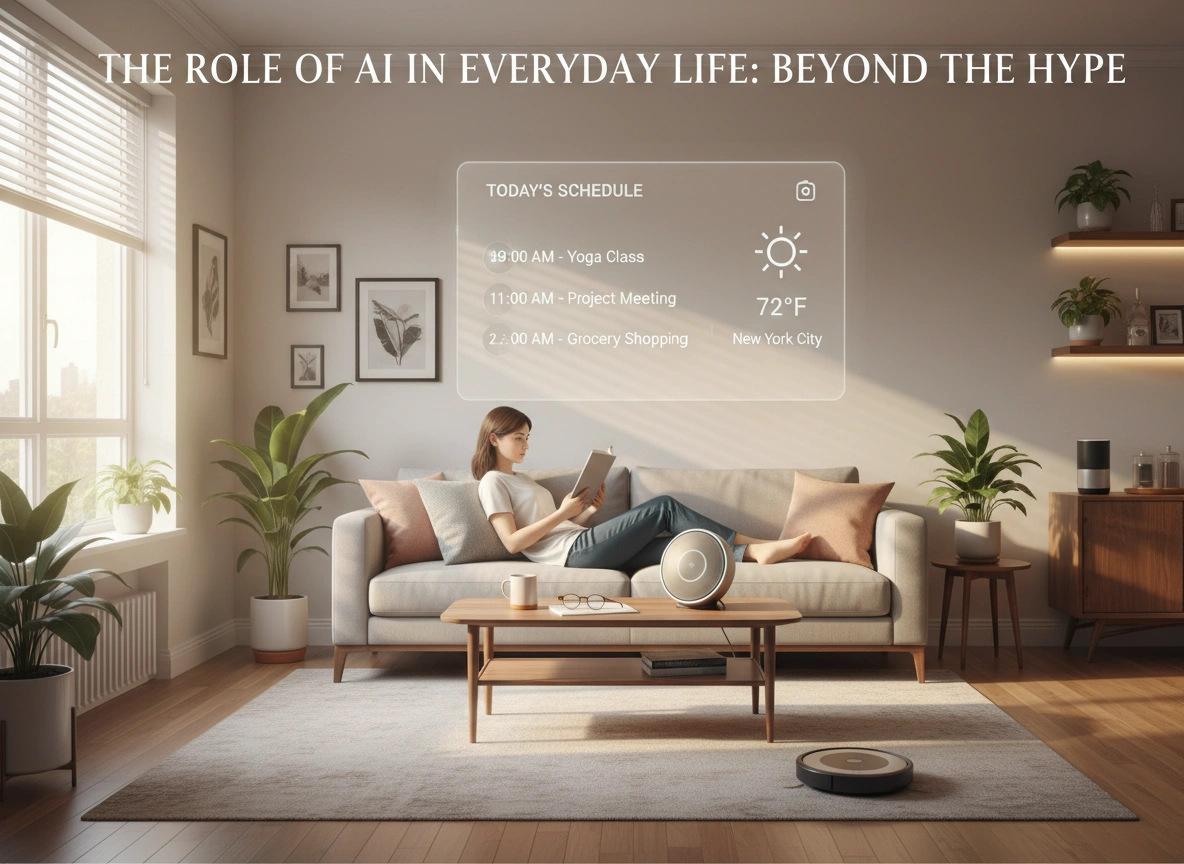
Artificial intelligence often conjures images of futuristic robots or complex coding screens, but the reality is far more subtle and ingrained in our daily routines. AI isn’t just on the horizon; it is already here, quietly reshaping how we work, learn, travel, and heal.
This article explores the pervasive role of AI in everyday life, examining its integration into healthcare, education, transportation, entertainment, and personal productivity. We will look at real-world examples, the tangible benefits we enjoy, the challenges we face, and what the future holds for this transformative technology.
Personal Productivity: The Invisible Assistant
Most people interact with AI within minutes of waking up, often without realizing it. From unlocking a phone with FaceID to asking a smart speaker for the weather, AI algorithms are constantly working to streamline our mornings.
Smart Assistants and Home Automation
Voice-activated assistants like Siri, Alexa, and Google Assistant rely on Natural Language Processing (NLP). They don’t just “hear” words; they interpret intent, context, and nuance to perform tasks like setting reminders, playing music, or controlling smart home devices. Smart thermostats like Nest use machine learning to learn your schedule and temperature preferences, automatically adjusting to save energy when you leave the house.
Email and Communication
If you use Gmail, you’ve seen AI in action via “Smart Compose” and spam filtering. AI algorithms analyze millions of emails to identify patterns that indicate spam or phishing attempts, keeping your inbox clean. Furthermore, predictive text features suggest the next word or phrase in your sentence, speeding up communication and reducing repetitive typing.
The Benefit: These tools reduce cognitive load. By automating mundane tasks—like organizing schedules or filtering junk mail—AI frees up mental energy for more complex decision-making.
Healthcare: Precision and Prevention
Perhaps no sector has seen more profound implications from AI than healthcare. It is moving medicine from a reactive model—treating you when you are sick—to a proactive one.
Diagnostic Imaging
Radiologists use AI-powered tools to analyze X-rays, CT scans, and MRIs with incredible speed and accuracy. For example, Google Health developed an AI model that detects breast cancer in mammograms with greater accuracy than human experts, reducing both false positives and false negatives. These tools don’t replace doctors; they act as a second pair of tireless eyes that never get fatigued.
Wearable Health Tech
The Apple Watch and Fitbit are more than just pedometers. They use AI algorithms to monitor heart rate variability, detect irregular rhythms (atrial fibrillation), and even measure blood oxygen levels. These devices provide continuous data streams that can alert users to potential health crises before they become emergencies.
Drug Discovery
Traditionally, developing a new drug takes over a decade and costs billions. AI is shortening this timeline significantly. By simulating how different molecules interact with biological targets, AI can predict the efficacy of potential drugs much faster than traditional lab testing.
The Challenge: While the benefits are immense, privacy concerns regarding patient data are significant. Ensuring that sensitive health data used to train these AI models remains secure and anonymous is a critical hurdle.
Transportation: Safety and Efficiency
The transportation sector is undergoing a revolution driven by AI, aiming to make travel safer and logistics more efficient.
Navigation and Traffic Management
Apps like Google Maps and Waze are classic examples of AI in daily life. They analyze real-time traffic data from millions of users to optimize routes, predict arrival times, and suggest detours around accidents. This dynamic routing reduces congestion and lowers fuel consumption.
Autonomous Vehicles
While fully self-driving cars are not yet ubiquitous, the building blocks are already in most modern vehicles. Features like adaptive cruise control, lane-keeping assist, and automatic emergency braking rely on computer vision and sensor fusion—core AI technologies—to interpret the road environment and react faster than a human driver.
Ride-Sharing Optimization
Companies like Uber and Lyft use complex machine learning algorithms to match riders with drivers, determine pricing based on demand (surge pricing), and optimize pickup locations to minimize wait times.
Future Implication: As autonomous technology matures, we may see a shift away from individual car ownership toward “mobility as a service,” drastically reducing the number of vehicles on the road and reshaping urban planning.
Education: Personalized Learning Paths
The “one-size-fits-all” approach to education is slowly becoming obsolete thanks to AI. Technology is enabling a more personalized learning experience that adapts to the pace and style of each student.
Adaptive Learning Platforms
Software like Khan Academy and Duolingo uses AI to assess a learner’s performance in real-time. If a student struggles with a specific math concept, the system provides additional practice problems or alternative explanations. Conversely, if a student masters a topic quickly, the system advances them to more challenging material, preventing boredom.
Automated Grading and Feedback
AI tools can now grade multiple-choice tests and even evaluate essays for grammar, structure, and plagiarism. This automation saves teachers hours of administrative work, allowing them to focus more on mentorship and direct student interaction.
Accessibility Tools
For students with disabilities, AI is a game-changer. Speech-to-text tools help students with physical impairments write essays, while text-to-speech applications assist those with visual impairments or dyslexia in accessing course materials.
The Benefit: Democratization of quality education. AI tutors can provide high-quality, personalized instruction to students in remote or underfunded areas, helping to bridge the educational divide.
Entertainment: Curated Experiences
Have you ever finished a show on Netflix and immediately clicked on the “Recommended for You” title? That is AI at work.
Content Recommendation Engines
Streaming services like Netflix, Spotify, and YouTube rely heavily on recommendation algorithms. These systems analyze your viewing or listening history, compare it with millions of other users with similar tastes, and predict what content you will enjoy next. This keeps users engaged and helps them discover niche content they might otherwise miss.
Content Creation
AI is also moving into the creative side. Tools can now compose music, generate realistic background art for video games, and even de-age actors in movies. In video games, AI controls non-player characters (NPCs), making them react realistically to the player’s actions, creating more immersive and challenging experiences.
The Challenge: The “filter bubble.” By constantly feeding us content that aligns with our existing preferences, AI algorithms can inadvertently limit our exposure to diverse viewpoints or new genres, creating echo chambers.
Challenges and Ethical Considerations
While the integration of AI into everyday life offers remarkable benefits, it is not without risks.
- Job Displacement: Automation threatens jobs that rely on repetitive tasks. While AI creates new roles, there is a painful transition period where the workforce must reskill.
- Bias and Fairness: AI systems learn from human data, which often contains historical biases. If an AI used for hiring is trained on data from a company that previously hired mostly men, the algorithm may unfairly penalize female applicants.
- Privacy: The convenience of AI often comes at the cost of data privacy. Smart speakers are always listening for a wake word, and navigation apps track our every movement. Balancing utility with privacy rights is an ongoing societal debate.
Conclusion
The role of AI in everyday life is no longer a subject of science fiction; it is the infrastructure of our modern reality. From the moment we check our phones in the morning to the route we take to work and the shows we watch at night, AI is the silent engine driving efficiency and personalization.
As we look to the future, the integration will only deepen. We can expect smarter homes that anticipate our needs, healthcare that predicts illness before symptoms appear, and education systems that unlock every student’s potential. However, navigating this future requires vigilance. We must actively address the ethical challenges of bias, privacy, and employment to ensure that AI remains a tool that serves humanity, rather than one that divides it.
By understanding how these systems work, we can better leverage their power to improve our lives while advocating for responsible development and implementation.
Please click here for more info.

