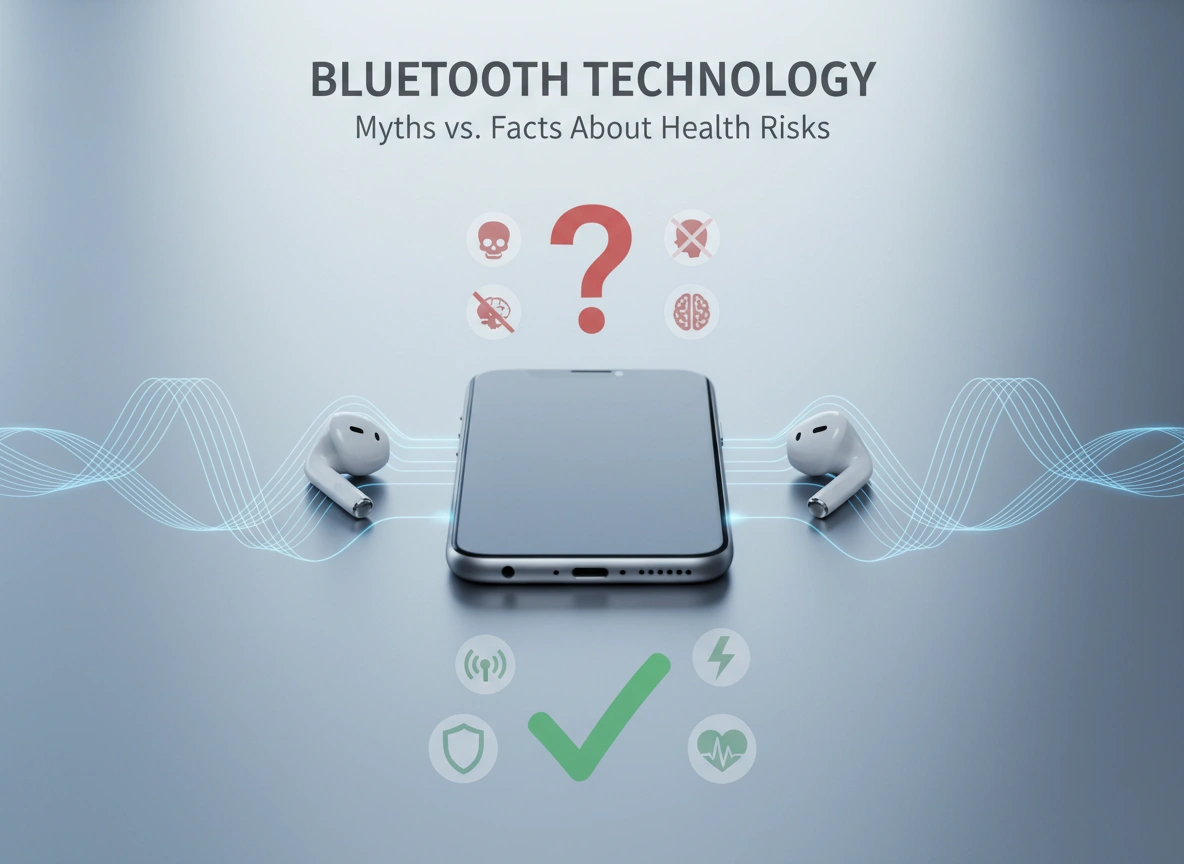
Every day, billions of us plug wireless earbuds into our ears, sync our smartwatches, and connect our phones to our cars without a second thought. Bluetooth technology has become the invisible glue holding our digital lives together. Yet, despite its ubiquity, a cloud of uncertainty hangs over it for many people. You might have heard whispers at a dinner party or seen a viral social media post claiming your favorite wireless headphones are frying your brain.
Concerns about invisible waves carrying data through the air are understandable. We can’t see Bluetooth signals, so it is easy for misinformation to fill the void. Are we sacrificing our long-term health for the convenience of being wire-free?
The purpose of this article is to separate the science fiction from the science facts. We will look at how Bluetooth works, examine the specific radiation it emits, and tackle the most persistent myths about its health risks head-on. By the end, you will have a clear, evidence-based understanding of whether you need to worry about that headset.
Understanding Bluetooth: What Is It?
Before we can debunk the myths, we need to understand the mechanism. Bluetooth is a short-range wireless communication technology. It uses radio waves to transmit data between devices over short distances.
The Radio Frequency Spectrum
Bluetooth operates in the 2.4 GHz frequency band. This is the same neighborhood of the electromagnetic spectrum used by your microwave oven and your Wi-Fi router. However, the way these devices use that frequency is vastly different.
Radio waves are a form of electromagnetic radiation (EMR). The word “radiation” often triggers alarm bells because we associate it with nuclear disasters or X-rays. But in physics, radiation simply refers to the emission of energy.
Ionizing vs. Non-Ionizing Radiation
This distinction is the most critical concept in understanding wireless health safety.
- Ionizing Radiation: This type of radiation carries enough energy to remove tightly bound electrons from atoms, creating ions. This process can damage DNA and cells. Examples include X-rays, gamma rays, and ultraviolet (UV) light from the sun. We know these are harmful in high doses.
- Non-Ionizing Radiation: This type has lower energy. It does not have enough power to break chemical bonds or strip electrons from atoms. It can, however, excite molecules and generate heat. Bluetooth, Wi-Fi, radio, and microwave signals all fall into this category.
Bluetooth emits non-ionizing radiation. The primary biological effect of non-ionizing radiation is heating, not genetic mutation.
The Power Output Factor
Why is your microwave dangerous if you climb inside it, but your Bluetooth headset isn’t? The answer lies in power and intensity.
A typical microwave oven uses about 1,000 watts of power to heat your food. In contrast, Bluetooth devices are incredibly weak. Most consumer Bluetooth devices (like headphones) operate as “Class 2” or “Class 3” devices.
- Class 1: Up to 100 milliwatts (mW) – Used for long-range industrial applications.
- Class 2: Up to 2.5 mW – The standard for most mobile devices.
- Class 3: Up to 1 mW – Very short range.
To put this in perspective, your smartphone, when transmitting a cellular signal (using 4G or 5G), can emit power hundreds of times stronger than a Bluetooth signal. The energy emitted by your wireless earbuds is a tiny fraction of what your phone emits just searching for a cell tower.
Myth #1: Bluetooth Headphones Cause Brain Cancer
This is the most pervasive and frightening myth. It gained traction after a petition signed by 250 scientists was circulated regarding non-ionizing electromagnetic field (EMF) exposure. While the concern is valid for study, the headlines often distort the reality.
The Fact
There is currently no conclusive scientific evidence linking Bluetooth radiation to brain cancer.
The prestigious National Cancer Institute and the World Health Organization (WHO) have reviewed decades of research on non-ionizing radiation. The consensus remains that at the low power levels used by consumer electronics, there is no mechanism for this radiation to cause cancer.
The “heating” effect mentioned earlier is negligible with Bluetooth. The power is so low that your body’s natural blood circulation dissipates any minute heat generated before it can damage tissue. Standing in direct sunlight warms your head significantly more than wearing Bluetooth headphones ever could.
Myth #2: Wired Headphones Are Completely Safer
Many people switch back to wired headphones believing they eliminate radiation exposure entirely. This seems logical: remove the wireless transmitter, remove the risk.
The Fact
While wired headphones do not emit Bluetooth signals, they are not completely devoid of EMFs. Any wire carrying an electrical current generates a small electromagnetic field. Furthermore, if your phone is in your pocket while you use wired headphones, the phone itself is still emitting cellular radiation right next to your body.
Because the radiation from Bluetooth is so incredibly low—far below international safety limits—the “safety gap” between wired and wireless is practically non-existent. Choosing wired headphones is a valid preference for audio fidelity or battery life, but doing it strictly for health reasons is not supported by current data.
Myth #3: Bluetooth Radiation Damages the Blood-Brain Barrier
The blood-brain barrier is a vital filtration system that prevents harmful substances in the blood from entering the brain. Some early, isolated studies on rats suggested that exposure to high levels of radiofrequency radiation could cause this barrier to leak.
The Fact
These studies often used radiation intensities far higher than what a human experiences from a Bluetooth device. Furthermore, the scientific community has struggled to replicate these results consistently.
Reviews by major health agencies, including the FDA (U.S. Food and Drug Administration), indicate that current exposure limits are set well below the levels where such biological effects occur. Your Bluetooth headset simply does not have the power required to disrupt the blood-brain barrier.
Myth #4: Children Are at Higher Risk from Bluetooth
Parents are naturally protective. There is a common belief that because children have thinner skulls and developing nervous systems, they absorb more radiation, making Bluetooth dangerous for them.
The Fact
While it is true that children can absorb more radiation than adults due to their physiology, the source matters. Most health organizations advise limiting screen time and keeping cellular devices (phones and tablets) away from young bodies when they are transmitting heavy data.
However, because Bluetooth signals are so weak (often 100 to 1,000 times weaker than cellular signals), they are not considered a primary risk factor. The greater health risk for children using headphones is actually noise-induced hearing loss. Listening to audio at high volumes damages the delicate hair cells in the inner ear, a problem that is well-documented and permanent.
What Does the Science Say?
It is important to look at the hierarchy of evidence. We rely on large-scale epidemiological studies and lab research verified by international bodies.
- The World Health Organization (WHO): They classify radiofrequency electromagnetic fields as “possibly carcinogenic to humans” (Group 2B). This sounds scary, but it puts RF fields in the same category as pickled vegetables and aloe vera leaf extract. It essentially means “we can’t rule it out completely, but we haven’t found a definite link yet.”
- The FDA: They state that “the weight of scientific evidence has not linked exposure to radio frequency energy from cell phone use with any health problems.”
- The Federal Communications Commission (FCC): The FCC sets strict limits on the Specific Absorption Rate (SAR), which measures how much RF energy the body absorbs. Bluetooth devices fall significantly below these limits.
The scientific method is about rigorous testing. If Bluetooth caused significant harm, we would expect to see a massive spike in brain tumors correlating with the explosion of wireless device usage over the last 15 years. We simply have not seen that statistical trend in the general population.
Practical Tips for the Cautious User
Even though the science indicates Bluetooth is safe, some users prefer to exercise the “precautionary principle.” If you want to minimize your overall EMF exposure for peace of mind, here are reasonable steps you can take:
- Don’t Keep It In All Day: Take your earbuds out when you aren’t using them. This is good for your ear hygiene anyway.
- Distance Matters: Radiation intensity drops off sharply with distance. If you are on a call, putting your phone on a desk and using a Bluetooth headset might actually lower your total exposure compared to holding the high-power phone directly against your head.
- Limit High-Power Devices: Focus your caution on devices that emit higher energy, like the smartphone itself. Carry it in a bag rather than a pocket when possible.
- Watch the Volume: As mentioned, the volume dial is more dangerous than the wireless signal. Keep listening levels at 60% or lower.
Conclusion
Technology evolves faster than our ability to study its long-term effects over decades, which naturally breeds anxiety. However, based on our current understanding of physics and biology, Bluetooth technology presents no significant health risk to users.
The radiation emitted is non-ionizing and extremely low power—too weak to damage DNA and too weak to heat tissue. While the internet is full of alarming anecdotes, the rigorous data from global health organizations tells a much calmer story.
You can continue to enjoy your morning jog with wireless earbuds and sync your smartwatch without fear. The freedom of wireless connectivity does not appear to come at the cost of your health.Please click here for more info.
You may also read: The Power of Dragon Fruit: A Superfood Deep Dive

